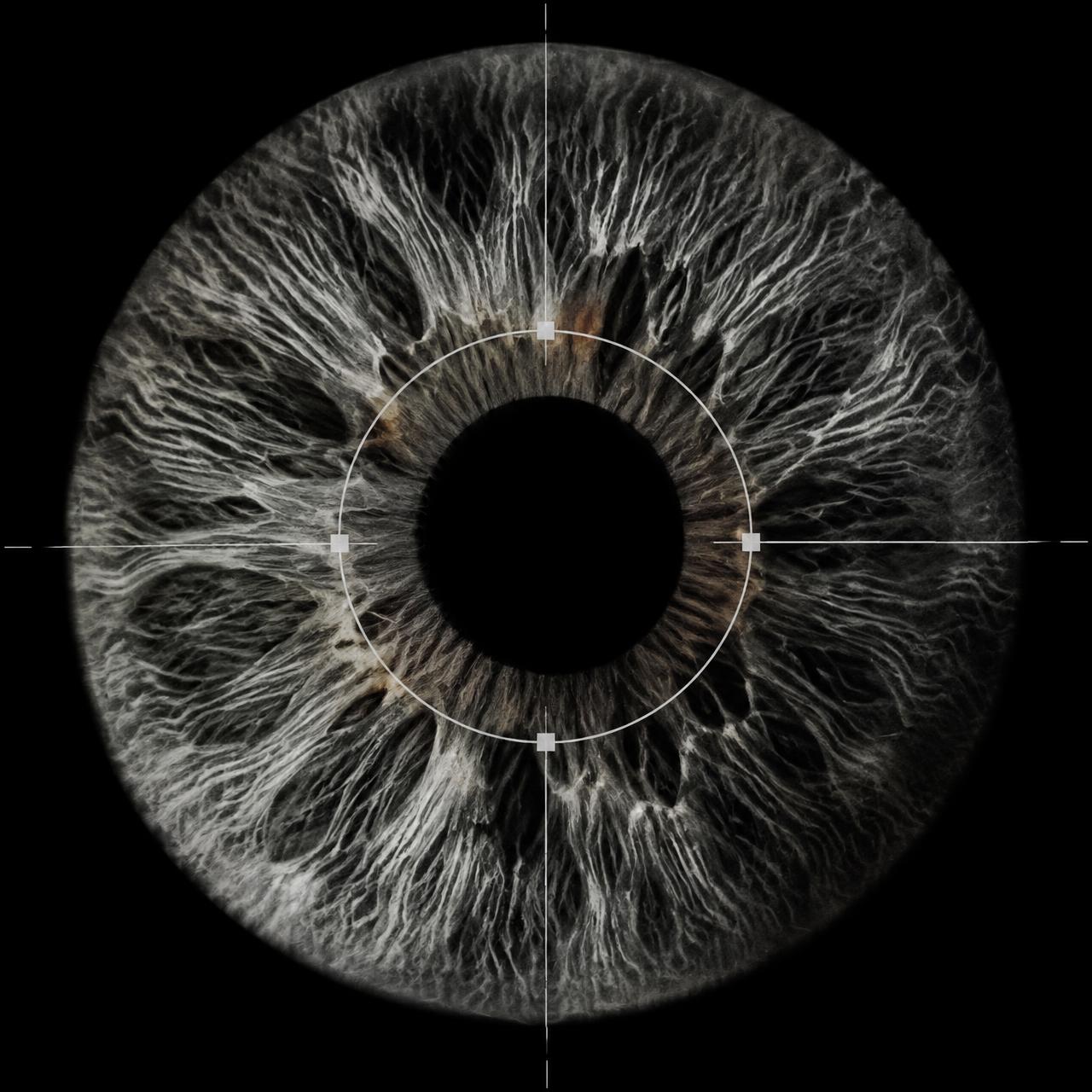
Your eyes change
over time. The record
should too.
Most eye information is still captured as isolated moments: an examination, a photograph, a message to a clinician, a test result.
EyeHealthIntel begins with a different premise: the eye should have a longitudinal record. A record that can grow over years, across devices and — where consent, validation and regulation allow — across healthcare contexts.
Patent pending · Ravolution AB · Sweden
The question
What if the most important change is not what the eye looks like today?
A photograph answers: What did this eye look like at this moment?
A longitudinal record asks a much more interesting question: What changed?
That distinction sits at the centre of EyeHealthIntel.
Medicine has learned the value of longitudinal information almost everywhere else — heart rhythm, blood pressure, glucose, sleep, weight, activity, laboratory values.
Yet for most people, there is no persistent visual record of their eyes.
The camera capable of beginning that record is already in billions of pockets.
Philosophy
From the examination
to the continuum.
Healthcare is often episodic.
We seek help when something feels wrong.
A professional observes us for a moment.
The moment is documented.
Then life continues.
But biology does not operate in appointments. It changes continuously.
The deeper idea behind EyeHealthIntel is therefore not simply “AI can analyse an eye photograph.” It is:
What becomes possible when a person can build a structured visual history of their eyes over years?
A single image may be ambiguous.
Comparable images may establish context.
Observations across populations may generate research questions one snapshot never could.
The invention is therefore as much about time, comparability, quality and provenance as it is about artificial intelligence.
A deliberate boundary
The phone is
not the doctor.
EyeHealthIntel is not based on the premise that a smartphone should replace ophthalmologists, optometrists, retinal cameras, OCT, slit-lamp examination or clinical judgement.
Can the device people already carry create better structured information before, between and around professional encounters?
That distinction shapes the architecture
- 01Bad images can be rejected rather than guessed from
- 02Unsupported analyses return NOT_ASSESSABLE
- 03Scientific evidence is separated from emerging research
- 04Traditional interpretations never enter Clinical
- 05Models and evidence remain versioned
- 06Clinical functions remain locked until separately validated and released
“Responsible intelligence must be allowed to say: I do not know.”
The system
Not an eye-scanning app.
An eye intelligence infrastructure.
- 01Device↓ Device capability profile
- 02Capture↓ Guided eye imaging
- 03Quality↓ Focus · exposure · glare · visibility · framing
- 04Record↓ Immutable original + metadata
- 05Time↓ Longitudinal normalization
- 06Evidence↓ Scientific · Research · Traditional separated
- 07Intelligence↓ Only permitted outputs
- 08Connection↓ Consumer · telehealth · API · FHIR · research
The defensible system is the chain, not a single AI prediction.
Mission
An eye record for anyone
who can reach a compatible camera.
Our mission is to make longitudinal eye intelligence accessible, structured and useful — without lowering the standards of evidence required for healthcare.
Start with hardware people already own.
Turn isolated captures into a record over time.
Keep evidence, model versions, consent and provenance attached to every permitted output.
Patent pending · Swedish application 2630671-2. EyeHealthIntel is consumer and pre-clinical infrastructure. It does not diagnose disease, and clinical functions are not released.